Poetry

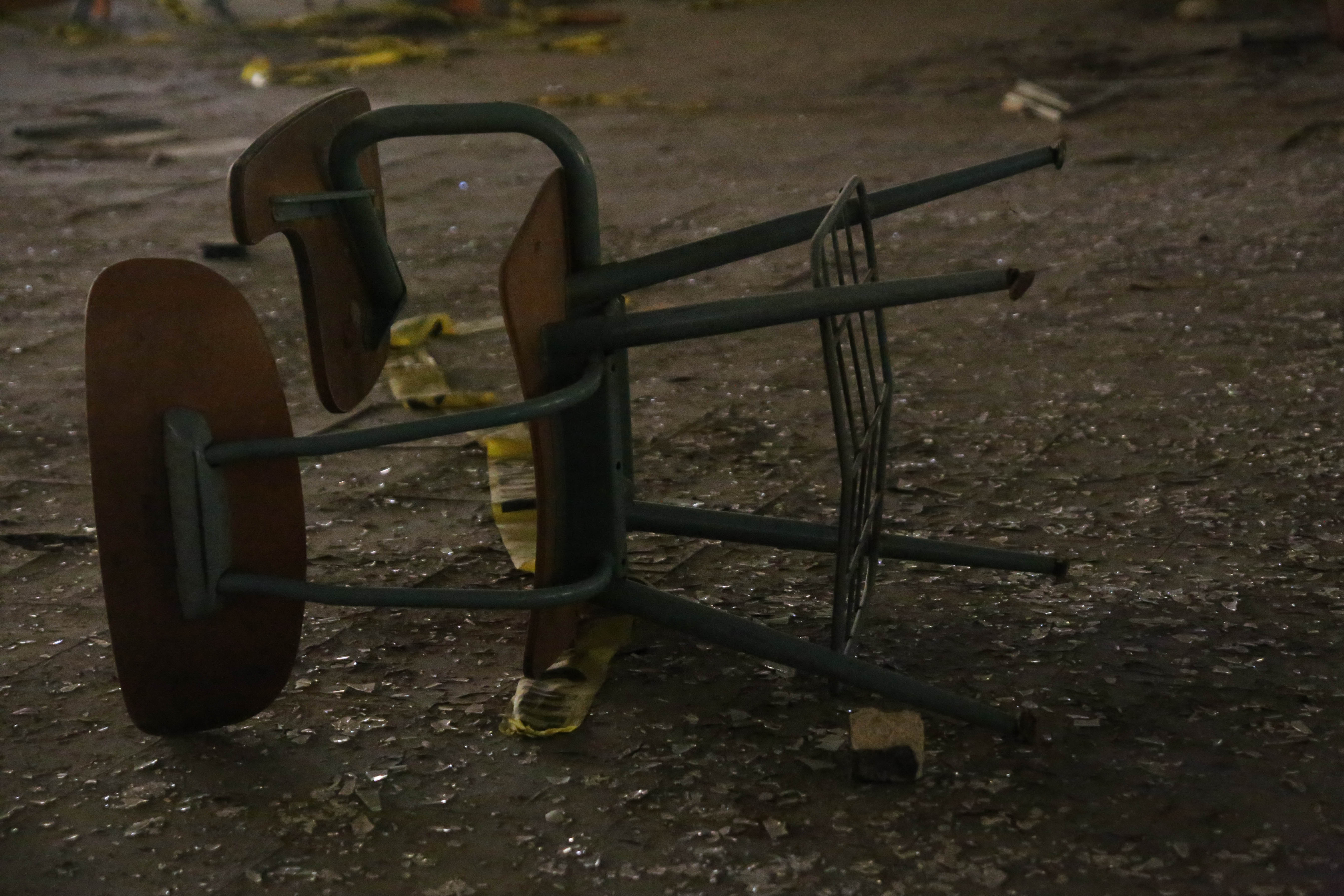
The First Day at School with an Empty Seat

When you’re gone we just don’t
talk about you anymore,
don’t mention your existence
or the sudden absence of it,

much less still our lips for a minute
of silence sacrificed in your name.
The quiet we cover you up with
is colder than that,
less like a burial with its awful, haunted wailing
and more like a neat, clean, pink eraser
in the hands of a businessman
who assures you it isn’t personal.

Not personal:
therein lies the poison.

The system, we are assured,
can chug along without you—
you, a replaceable cog or piston—
so don’t worry about the collateral damage
if you ever find yourself suddenly missing,
because instead of dropping to our knees in the snow,
scratching and ripping
at the dead grass and dirt
till we unearth a deeper pain
and clearer purpose for living,
we’ll be so fine it will make you
uncomfortable.

We pretend that the pond
has no ripples post-stone,
and what scares me most
is if we spend enough days
running out far away from the
center of the center of our
soul-centered self like this,

eventually
it won’t.
Poetry

Epilogue: They Remembered How to Shine, and Why

Let’s stick with the commas, kid;
keep me on the script.
I can take them and toss them
throughout your Google doc
with precision, no problem;
I can answer every question
about grammar and plot—

but I don’t know what to say
about your grandpa,

why a good man
came home from
all-the-way-in-Africa
only to be lost again.

I could give you a guess,
repeat some tight
theology I think you
know by now
(the curse we all still cough on,
the corpse who conquered death),
but you never were the type
to need help reading
any text.

It feels like every year
I end up understanding less:
why mercy doesn’t earn respect,
why we take the side
of see-through lies
and sleep in the arms of our destruction,
why the patriarchs and prophets die,

why he had to wait
beneath the whip so long
before they let him lift
his own undoing up
upon his shoulders,
I don’t know—
and was each moment of it
necessary to balance out
the great cosmic equation
for my soul?
Would a pistol to the temple
not have been enough of hell
to pay my dues
and let me go?

Did he question?
Did he know,

or did the stars above Gethsemane
hear so much doubt laced in his pleas
that they lost the heart to shine that night
for fear all hope
had been a lie?

Poetry

Almost Like Closure

Just one step closer to closure at a time—
one more court date over,
one less long wait slower—
one more inch along the way
toward happily afters and all better now—

or maybe grief is more a door
that never closes like a lock.
No permanent click,
no absolute end,
no gavel drop of perfect justice
to put the heartache behind bars.

It comes, and it fades,
and you learn to live
with a shadowed nuance
that sits on your shoulders on certain days
more so than others,
finicky like fog.

Over time, you learn to use your headlights
and pull your way carefully down the road,
even inside the densest cloud.
You might drive twenty-five miles an hour
when you have to,
but you never stop, not now.
You have somewhere to go,
goals shining like cities on the maps of your mind,
and you know that the light
always clears up later.

You squint through the grey
and the unanswered questions,
the rage and regret,
memories that won’t settle,

and in spite of it all
your foot hugs the gas.
You keep driving forward,
your heart full of past.

Poetry

What I Do and Do Not Know

I don’t know what gave you
the courage 
to feed your fear so completely,
to let that single moment
turn eternity-permanent. 

Maybe it was the demons
who had caught you with claws
and with shudder, forced your head under
a spell that you couldn’t resist.
Maybe the despair 
said a curse that you couldn’t unhear,
and you believed it,
those lies of never and better off
that your friends never would have 
believed about you, if only you knew.
Maybe you didn’t really mean to—
you were thinking about it,
but you didn’t think that you’d do it,
until your finger slipped too close
to an accident you couldn’t undo.

Or maybe it was just a stupid mistake,
like we all make,
only bigger—
like the fib we find ourselves defending,	
the one drink too many,
the best friend unfriended,
the baby in the belly at too young an age—
you did something stupid
in the heat of a moment,
but unlike us lucky ones,
you picked the one scar
that the years don’t let go of.

I don’t know why
you left me.
I can’t even fathom
what you must have been thinking,

but I can choose what I’m going
to go on thinking about you, 
and it’s not this.
I refuse to frame your face
with a casket;
I will not define you
by your dumbest regret.

I know who you were, friend,
despite what you did once,
and that’s what I hold onto
in the aching wide space that you left.
You’re laughter that crackled
bright songs past my static,
kindness incarnate,
gentlest friend,
and with you, I could stare down
an enemy army
cause you’d have my back
no matter what attack fractured in. 

That bullet? It happened to you, yes,
but it’s not who you were. 

I know your name,
and in my memory,
you’re still shining the same.
Poetry

The Familiar Dark

Nevermind the sunlight
with its whispers of another try.
Blacken out dawn’s maddening grin,
and in your everlasting dark
scribble over every dream
that dares to pry its way inside.
Simply plug your ears and scream
over hope’s sadistic singing

till you are left alone
under the comfortable
covers of despair,
cocooned in stillness
and commiseration,
not threatened by the awful glow
of any hard-earned glory
that you haven’t known.

Poetry

Escape Artist in Training

You have to lock the strongest hearts
behind bars sometimes.
Though it isn’t fair—
though it may not be right—

The darkness needs to keep them there,
not because it’s mean,
but because it’s scared
of the buried power and the love-tipped prayers,
the glaring light that might leak wide
on the bleak-eyed shadows
if it let them loose.

But the goodness, too, and the champions
and the angel armies all agree
that it’s best not to break in
and set them free,
not because they’re uncaring,
but because they know
that strong hearts need iron
to help them grow.

They can take the metal,
though it bruises their souls—
they can make it out,
though not alone.
Their fingers, too thin,
will toughen to pry
the ceiling open into sky.

Strong hearts sometimes cry—
but they still come out stronger,
and when pain multiplies,
they just hold out longer.

Sometimes justice turns its head
as they lock an innocent heart away
because mercy remembers
the powerless prisoners,
the weak and the wobbly,
sick and unsteady
who’ve forgotten to fight
every guard that’s in sight,
who need a strong heart’s hand to hold,
need to hear a strong song
blast notes of hope
through the underground empty
and the frozen below.

Great men need prison
and all its compassion,
for strong hearts recall,
and they always come back
to rescue the next heart trapped
in that same old cage,
saying, “I know the way out.
And I will keep you safe.”

Heroes aren’t born;
they grow from the ground.
They’re buried in holes,
and they break their way out.